


04 July Chart Decoder Series: Probabilistic Oscillator – Trader’s Radar for Reversal
In education
Welcome to the Chart Decoder series, a guide to learning the essential tools to accurately read Bitfinex charts.
So far, I’ve learned how to spot trends (SMA/EMA), catch momentum shifts (MACD), and how to recognize excess/sold out zones (RSIs) and volatility extremes (bollinger bands).
So let’s talk about stochastic oscillators. This is an indicator of timing moments “too fast”;
What is a probabilistic oscillator?

Stochastic oscillators measure momentum by comparing the current closing price to the high and low ranges over a set period (usually 14 periods).
It consists of two rows.
- %k (high speed line): The main line responds immediately
- %D (slow line): Moving average %k that smooths noise
Typically, you get a reading between 0 and 100.
- Over 80 (%k): Too much bought. The market may need a breather
- Less than 20 (%k): Overselling. There may be a bounce
- Between 20 and 80:neutral. Prices have moved within recent ranges
Signal Crossover
- %k exceeds %d below 20: Bullish inverted signal
- %k is less than %d above 80: Bearish inverted signal
- If both lines are above 80 or below 20: It’s a strong trend, but it’s also a warning that you won’t get over the welcome. These zones often precede the shift.
Bitfinex BTC/USD example
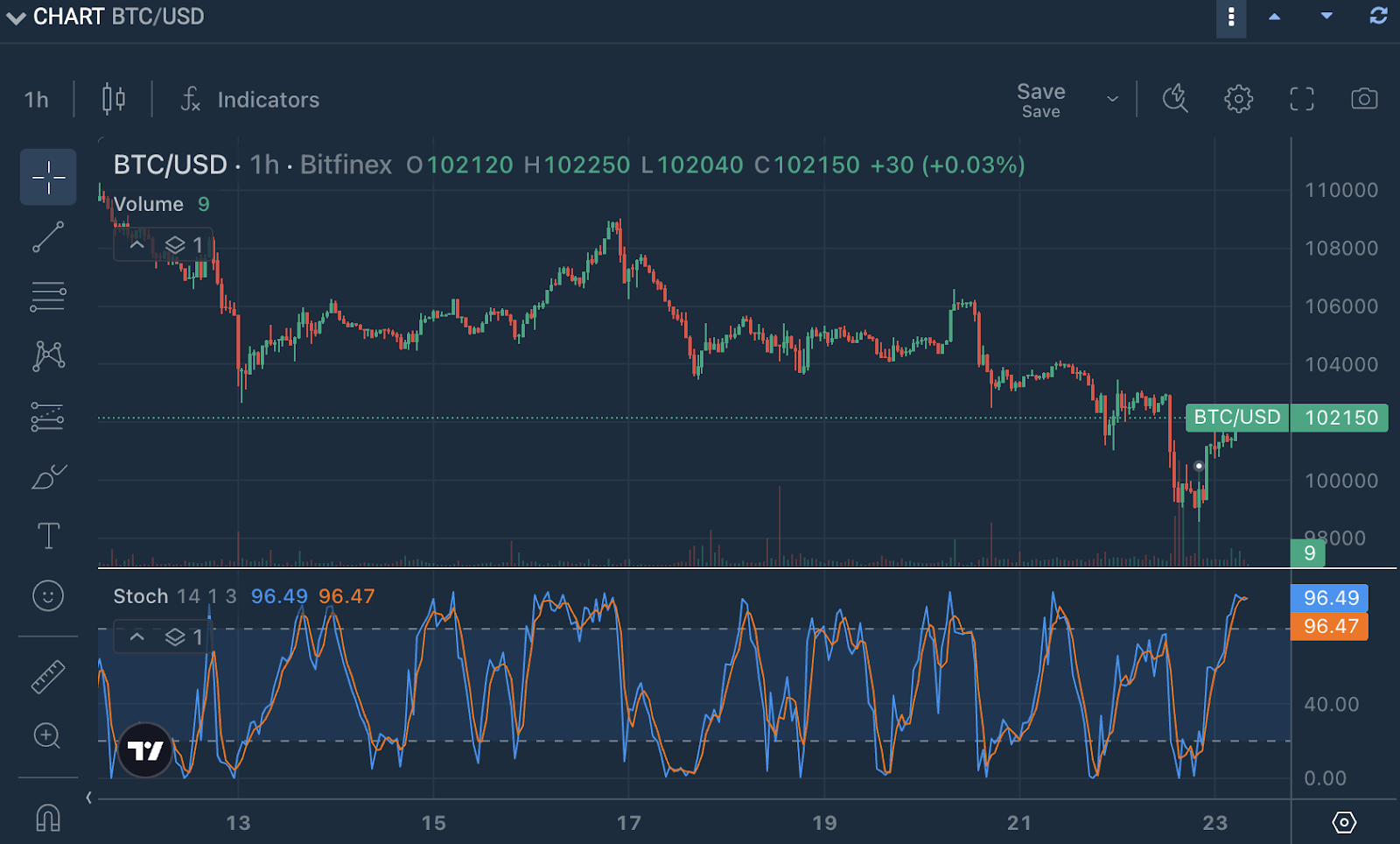
- price:$102,150.
- Blue (k%):96.49
- Orange (D%):96.47
- There are both rows Excessive zone (Over 80). This often indicates the potential fatigue of current upward movements.
Pumps these days may be overdoing that. When a probabilistic measure makes this higher, it often shows it Buyers may be short of gasand it could be that the pullback is round the corner.
But here’s a twist. In particular, in crypto, excessive acquisitions do not mean “time to sell.” With strong trends, probabilistic momentum indicators may remain high for some time. So, you need more clues before you make a call.
What other metrics are useful?
Stochastic oscillators offer easy reading of extreme extremes, but work even better when paired with other tools.
Moving average of index (EMAS) It helps to zoom out, like 50 or 200. If the BTC is bouncing off, but still below 200 EMA, it could be a short-lived rescue rally, not a true reversal of the trend.
Macd It functions like a momentum compass. Although they say the probability theory is over-bought, if the MACD is gaining strength in the upward direction, that might mean there is room for more driving.
rsiOn the other hand, there are close probabilities. It also flags over and oversell zones, but has a smoother and slower approach. It’s perfect for checking if momentum is built or fading. When used together, RSI and probability theory give you both direction and timing. One shows where the market is tilting. The other one will tell you when you’re coming back.
RSI vs. Probability – What’s the difference?
Both indicate whether the coin is “over-acquired” or “over-selled”, but they work differently.
| Features | rsi | Probabilistic |
| The best | It measures how strong the price movement has been these days. Check out big trends and breakouts | Indicates whether the price is at the top or bottom of the range. Catch a short-term reversal |
| Reading range | 0-100 | 0-100 |
| Too expensive (too much) | Over 70 | Over 80 |
| Too low (too sold) | Less than 30 | Less than 20 |
| Reaction speed | React more slowly due to the strength of the trend | Short ERM timing makes it faster and better |
Bonus Read: When adding RSI to a mix
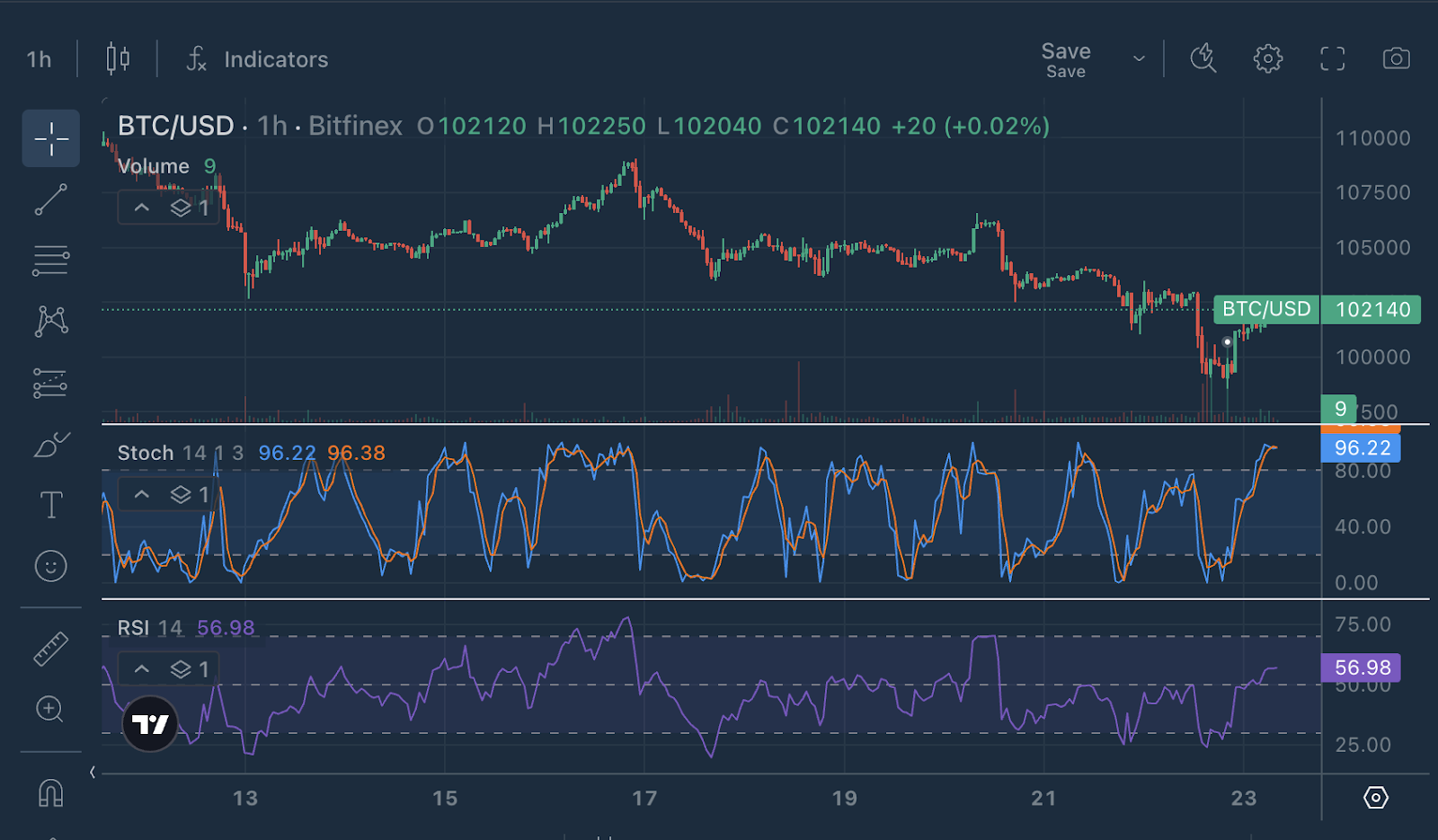
Layered to double check stochastic signals RSI (14) On the same BTC/USD chart. Here’s what we saw:
- Probabilistic It was over-buyed at 96+.
- rsi I sit comfortably 56.98to the right of the neutral zone.
This difference is interesting. Probability theory says “peak momentum,” but suggests that RSI is there There is still room for moving higher Before the trend is gone.
That discrepancy can often be shown Short-term indecisiveness Or even Opportunity to continueespecially when the volume starts.
So what’s moving? If the RSI breaks past 60 or 70 at a price-holding company, you may see this rally pushed further. However, if the RSI stalls and collapses probabilistically, it could be your early warning light.
Pro-use methods like probability theory:
- Checking is important: Don’t rely solely on probabilistic simultaneousness. Wait for the crossover and check the RSI or MACD.
- Don’t panic at every signal: It’s too much bought and can continue to be bought in a fierce bull market.
- Look for divergence: If the price is new and high but not probabilistic, momentum can fade and a reversal could come.
- Multiple time frames: A 15-minute chart signal makes little sense if every day is still trending.
Try it with Bitfinex:
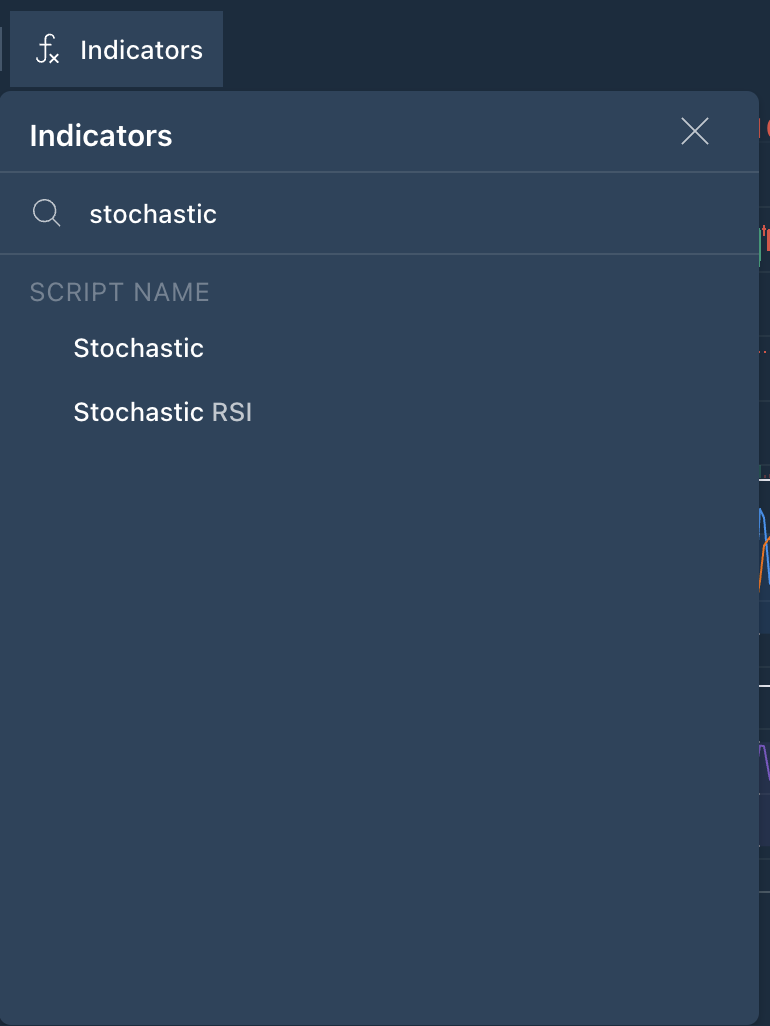
- Log in to Bitfinex
- Please select a chart
- Add a probabilistic oscillator
- Beware of extreme crossovers
Next chart decoder series: VWAP and how to determine whether a price is above or below “fair value.”
Bitfinex. Original Bitcoin exchange.
Discover more from Earlybirds Invest
Subscribe to get the latest posts sent to your email.


